

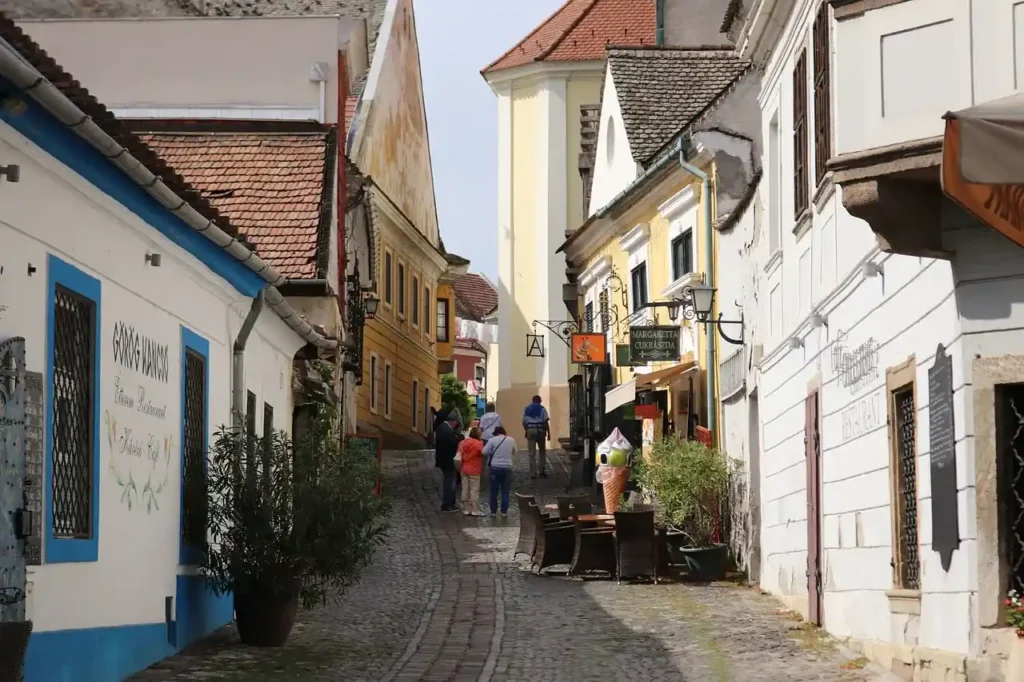
Situated on the Danube River’s west bank and nestled between Budapest and Pilis-Visegrád Mountains, Szentendreis a picturesque, artificial and museums brimming.
There are towns you look up on a map — and then there are towns that quietly find their way to you. Szentendre was that kind of place for me. Situated on the western bank of the Danube, between Budapest and the Pilis–Visegrád Mountains, it feels less like a town that was built and more like one that was carefully painted into existence. Just a short ride from Budapest, yet worlds away from its rhythm, Szentendre rests between river reflections and mountain whispers. Here, colour is not only seen but felt — spilling from pastel facades, tiled rooftops, art studios, and café windows where time seems content to slow down and watch.
Why I would return to Szentendre
From the very first steps I took through its streets, I had the feeling that Szentendre breathes art. Set in a quiet pocket near the Hungarian capital, it feels shaped by artists rather than planners. As a photographer and storyteller, I was drawn in immediately — and I know I’m not the only one. Almost everyone who loves observing, wandering, and capturing details will recognise that feeling on first sight.

By mid-morning, the narrow alleys begin to hum softly with footsteps and conversation. I remember hearing brushes tap against glass jars inside small ateliers, coffee spoons clinking gently in porcelain cups. I didn’t walk with a plan — I drifted. Through galleries scented with paint, across tiny bridges, past Orthodox church towers rising above a maze of red roofs. Every turn offered a small revelation: batik silk glowing behind a window, a mural half-hidden by ivy, an old violinist tuning his instrument near the main square.
What stayed with me most was Szentendre’s rhythm. It’s deeply connceted with the human art. A place that remembers how to breathe. Where others rush to rebuild, Szentendre repaints. Where others expand, it preserves. I didn’t come here to tick off attractions — I came to feel how beauty lingers quietly, somewhere between one breath and the next.
If you’re drawn to colourful streets, intimate squares, gentle promenades, and a remarkable concentration of museums, Szentendre has all of that. But more than anything, it offers atmosphere — the kind you carry with you long after you’ve left, like the soft echo of footsteps on stone.
Things to do in Szentendre
The baroque style and beautiful churches, Mediterranean atmosphere with the cobblestoned streets, unique architecture with narrow alleys and more than that should be discovered are hidden in picturesque Szentendre. I arrived early, when the morning light had barely brushed the cobblestones. The Danube was still half asleep, quietly mirroring the pastel houses that lean toward it like old friends. There’s a softness in Szentendre, a sort of fragile joy that artists have long tried to capture — and failed, because it lives not in what you see, but in how the place makes you slow down. It invites you to look longer, to notice how every corner has its own painter, its own muse, its own silence.

The artificial atmosphere will simply make you feel as the artisan on your own, photographing or paintingits colourful streets. Budapest’s proximity access by rail, own or public transport, and the Danube setting the Szentendre to be a popular destination for every visitor. In this post, I prepared the shortlist about the things to do and see in Szentendre, which has plenty of art colours in its churches facades, buildings, galleries, streets, squares, and museums.
“Fő Tér” – the main Square
This is the heart of Szentendre, and it’s always streamed here. From this point, you can easily access all of the places. A medieval town was rebuilt in the 17th Century. The main square is except the marvellous art churches surrounded by a selection of restaurants and shops. You’ll quickly notice the cobbled streets and old-style buildings, making this small place-unique gem of the Danube. If you wish to get more of Szentendre Fő Tér” – The Main Square is anideal place to start.
Blagovestenska Church
The church located just close to the main square is not considered the well known of the nine churches in Szentendre. This Greek-Orthodox church with Baroque-rococo design on its facade and architecture, dating back tothe 18th century.

Wooden frescos of St. Constantine and St Helene could be seen inside the church whilst the marvellous interior features beautiful iconostases.
Ur Eleonóra Batik Galeria
Exactly when you enter this little gallery in the very heart of Szentendre, you’ll feel the art in the real sense of this word. The artist works found here are painted onto silk using a batik technique. Almost all the inspiration of presented works here, the artists have used nature’s elements. The love of nature relies upon the right description of the bright colours combined with exquisite images to create something new. The number of hand-made pieces is presented to visitors for sale here. Eleonóra Batik Galeria will
Walking along Danube river
Besides being unique with the streets,Szetendre that is stranding the Danube Riveron its west side is also a destination for outdoor art enthusiasts. The Danube river flow is right what it makes the place linked with nature. Take just a few steps away from the central streets, and you’ll find yourself in the area bounded by the sound of the water flow, listening to the birdsongs. Take a look on to the Danube passing by, and maybe you’ll find some of the inspiration near it.

The artist’s motivation may not be deemed to be visible and significant for the first time. Still, the charming surroundings and Danube River would be the impact thatcould be made some of the most significant international artworks. While walking aside the Danube River, you simply shouldn’t miss capturing how the Szetendre does it look from this side. Maybe it will inspire the artist in you.
Szentendre art mill
The Szentendre art mill will present the marvellous art visitors with the gallery’s large exhibition of works across three floors. Outstanding results from local and international artists could be seen here. The visit is worth everyone who wants more experience in Hungary and Szentendre.
Caste Hill
If you’re the history type than the visit to Castle Hill will be worth of it. The fortress site from the Middle Ages was once here but has since been destroyed. However, what we see is the Gothic church of St. John the Baptist that remained. The church’s frescos belong to the 1930s and are painted by the artist’s colony members. When you finish overlooking the monument, let’s take a look outside of it. The magnificent view what could be seen from Castle Hill would be worth of visit.
Margit Kovács Museum
If you have more time of your visit to Szentendre, the Margit Kovács Museum will be an excellent place to spend some of the time in it. The museum isbearing the name about the artist Margit Kovács (1902-1977).
Take a look more in-depth into the beautiful collection consisting of several clay pieces, including pots, plates, statues, and tiles. The exhibits will let you know why one of the Szentendre’s best-known attractions. Many featured images that belonged to the artist’s mother work are highly connected with Hungary.
Retro Design centre
Most of the items listed here date back to the 1970s. A wonderful collection of furniture, electrical equipment, cars, kitchen items, and toys could be found here. Just like stopping in the time, these art items will take you in 1970-s. When you walk all the round, it is time to rest in some art bars or just get a look on to the Danube. The Szentendre also becomes official “the town of art” at the beginning of 20th Century when the artists have officially overtaken the houses to find inspiration for creating on this place. Let’s the site inspire you to become an artist as also.
Daily tours in Szetendre surround
There is no doubt the nearest Budapest is one of the most famed you can stroll for the days, and we will sure post own blog article for Budapest. The city divided by the River Danube in two once autonomous towns, Buda and Pest is the most populous Hungary city with around 3.3 million inhabitants. The official language spoken in Budapest is Hungarian, and the official currency is Hungarian forint. I liked the most to walk around the Danube alleys or at the central part Budapest streets. It’s clear there are so many of the other exciting places aroundwe would like and to visit and publish about them via GoatLet.
Getting to Szetendre
Located 26 kilometres far away from Budapest, the Hungarian capital Szentendre is the easiest way accessible from Budapest by train or bus. Budapest Public Transit is an app that helps to get around.
- By Plane: Budapest Airport (BUD) is about 16 km from the city and 50 km from Szentendre. It’s well connected to major European cities and serves as a hub for Wizz Air, LOT, Smartwings Hungary, and Ryanair. Transport to the city includes airport shuttles and public buses.
- By Bus: You can reach Szentendre from Budapest’s Népliget bus station (8 km from the city centre). Budapest is also well-connected by bus to cities like Zagreb, Ljubljana, Krakow, Vienna, and Bratislava.
- By Train: The easiest way to reach Szentendre is by train from Batthyány tér station in Budapest (Line 5). Note: Daily Passes don’t cover the trip to Szentendre—you’ll need an extra ticket from the station or the conductor.
- By Car: Hungary has five motorways and four major roads, most starting from Budapest. From Vienna/Bratislava, take the M1; from Zagreb/Ljubljana, follow E71; from Romania/Serbia, use E75.
- Parking in Szentendre: Parking is possible but limited. There are three zones; Zone 3 (along the Danube Promenade) is the most popular and most expensive. For further details when and where parking fee should be paid, you could check following a link.
Szetendre Info corner
📍 Where it lies: Just 26 km north of Budapest, Szentendre rests on the Danube’s west bank, embraced by the Pilis–Visegrád Mountains. A perfect day trip from Hungary’s capital.
🚶 Wander: Start from Fő tér, the lively main square, and follow the cobblestone lanes lined with pastel façades, galleries, and artisan shops. Don’t miss the riverside promenade for a peaceful walk under the plane trees.
⛪ Sacred corners: Among nine churches, Blagovestenska Church stands out — an 18th-century Greek Orthodox gem with baroque-rococo details and a serene wooden interior.
💧 Hidden gems: Step into Ur Eleonóra Batik Gallery for silk art inspired by nature, or visit the Margit Kovács Museum to admire Hungary’s beloved ceramic artist. For a nostalgic touch, the Retro Design Centre revives the spirit of the 1970s with vintage cars and home décor.
🐐 Putokoza tip: Go early in the morning, before tour groups arrive. Sit by the Danube with a notebook or camera — this is where Szentendre’s quietest beauty unfolds. Let the river teach you stillness.
🅿️ Practical: Reachable by suburban train (HÉV Line 5) from Budapest’s Batthyány tér. Driving takes about 30–40 minutes. Parking is available in three zones; riverside Zone 3 is closest but priciest. Comfortable shoes are a must — Szentendre is best seen step by step.