

Located in the southern part of the Istrian peninsula, Svetvinčenat is mystical and magical, situated at the historical border of the former Roman province of Istria, established during the Roman era.
Situated in the heart of southern Istria, where ancient routes once crossed, the medieval town of Svetvinčenat is home to one of the region’s oldest living traditions: the springtime procession honouring St. Vincent, when locals weave wild herbs into wreaths for good fortune.
Since the first Benedictine settlers began cultivating the red soil at a strategic location in the 6th century, Svetvinčenat (Savičenta, Sanvincenti) has developed at the intersection of roads between Pazin and Pula. Imagine those earliest monks stepping onto this scarlet earth, hands sinking into the warm soil as they tilled under spreading oaks. The quiet of dawn might have been broken only by the distant call of a herder or the tolling of a bell as the monks built their abbey close to key medieval crossroads between major Istrian towns, hoping for peace in a changing land. The settlement, named after St. Vincent (Sv. Vincent) and the eponymous medieval abbey, first appeared in written records from the 10th century (965), during a period when the area was transitioning from late antiquity to medieval rule.
Halfway between the west and east coasts, Svetvinčenat has historically played a very important role in trade and production, attracting merchants, soldiers, and knights, as well as wealthy travellers, travel writers, and artists. Today, visitors can wander the same medieval streets, pausing at a restored stone archway to taste locally produced olive oil from small family-run shops tucked within the centuries-old walls. The town’s cross-section of artificial architecture, dominated by medieval elements, will attract all seekers of picturesque places.
A walk through Svetvinčenat provides…enjoyment of medieval elements
Svetvinčenat is one of my favourite places to visit, inspiring me with something new each time I return. The colourful streets winding past Renaissance houses make this place feel truly magical. Every visit feels like a step back into the past, revealing scenes of medieval life filled with manufactories and merchants. Despite the passage of time, Svetvinčenat has certainly retained its authenticity. One of its most charming events is the “Choice of the Most Beautiful Goat,” which is always a highlight and just one more reason I love to share Svetvinčenat with fellow travellers.
City square
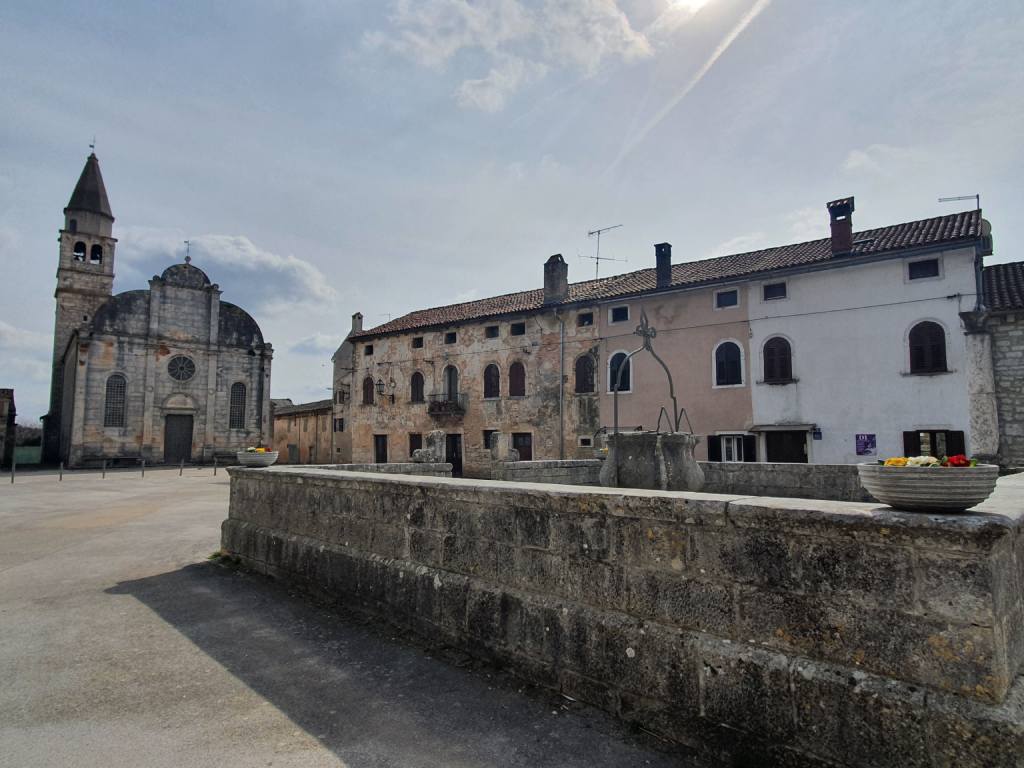
With a cistern at its centre, Placa Square features Renaissance architecture. As you step onto the weathered stone pavement, the gentle echo of footsteps blends with the distant sounds from a nearby café. The soothing warmth of sun-baked slabs and the subtle scent of Mediterranean herbs from nearby gardens greet visitors. Placa Square is framed by notable medieval landmarks: the Morosini-Grimani Castle, the parish church, a loggia, and various Renaissance houses. The loggia dates from the 18th century, while the elaborately carved cistern, built in 1808, sits at the heart of the square.
Morosini-Grimani Castle
The history of the 13th-century castle that dominates the medieval town can be learned through interactive exhibits today. Step inside the multimedia exhibition and, as you watch, sparks seem to leap from the blacksmith’s anvil in a 3D animation of sword forging, the clang of metal ringing beneath rhythmic music. In another room, see scenes depicting prisoners at the historical ‘Pillar of Shame,’ or find yourself in the simulated chaos of a castle siege, typical of attacks on noble residences during medieval and Renaissance times. Each interactive scene aims to immerse visitors in the castle’s turbulent history, which has been ravaged several times over centuries. The castle was demolished in 1329 during regional conflicts, then restored in 1485 under Francesco Morosini, a Venetian noble, in the Renaissance style. In 1560, the Grimani family, another prominent Venetian lineage, inherited the castle, giving it the current name Morosini-Grimani; their coat of arms is visible above the entrance. The defensive towers, crucial for the town’s protection, still dominate the landscape.
After ascending the balcony near the supporting wall, we peer into the “Captain’s Room,” notable for its artistic elements. The tale of the witch Mare and the equestrian games is reenacted through a simulated race inspired by today’s “Ring Race.” The castle preserves a collection of historic weapons, the “Ferlin” (14th–19th century).
The castle, which retains its medieval appearance, is remarkable for its original fortified towers. Three out of four still stand today. This makes it the best surviving example of medieval military architecture in southern Istria. At its peak, it could accommodate up to 200 horsemen. Inside its walls were weapons depots, a steward’s apartment, and a stable. After learning all that history, enjoying the view follows.
As you wander through the castle, glimpses of the world beyond its walls tease you at every turn—red rooftops spill into rolling green, the line of distant hills hints at grander sights yet to come. Then comes the moment you reach the top: the true panorama unfolds suddenly and spectacularly. On a clear, sunny day, the view stretches all the way to Učka Mountain, spanning both the eastern and western coasts of Istria. Not only can you capture the most picturesque postcard of Svetvinčenat from here, but you also realise that, in the Middle Ages, such vistas needed no modern technology to take your breath away.
The house of the witch, Mare
Located at the city’s entrance, the Mare Witch House attracts visitors with its rich cultural heritage. It showcases the history of Svetvinčenat through immersive 3D mapping, reminiscent of a castle experience. “Legend of the Unknown Horseman” transports visitors to the distant, mystical Middle Ages. This story features Mare Radolovich, a 17th-century witch-hunt victim, portrayed by her ghost. Beyond the story that transports visitors to this mystical era, the main role in defending Morosini-Grimani Castle is assigned to visitors through a virtual simulation. In 2020, the house introduced an interactive notebook featuring the mythical creatures of Istria as its main content.
Svetvinčenat offers an opportunity to explore diverse church architecture and historic frescoes
Svetvinčenat is considered one of the best examples of medieval urban planning in Istria, designed by Renaissance Venetian architects. Today, the town also preserves churches that span various architectural styles, as well as significant frescoes. This continuity of design and devotion can be observed as you explore buildings that reflect different eras, blending the medieval foundation with later artistic influences.
Parish Church of the Annunciation
Located in the eastern part of the square, the single-nave 16th-century church is one of the most beautiful Renaissance churches in Istria. The three-leafed Renaissance facade is made of Istrian stone. The main altar was built with donations from the Grimani family .
Frescoes in the church of St. Vincent and other smaller churches
The Romanesque single-nave church of the same name as the village—Svetvincenat—has three apses and dates from the 12th century. Hidden among tall, quiet cypresses, the church dedicated to St. Vincent, the patron saint, is the oldest preserved building in Svetvincenat. Three layers of frescoes, mainly from the late 13th century, decorate the interior. These form one of the most extensive Romanesque cycles of Byzantine-influenced frescoes in Istria. The frescoes are attributed to Master Ognoben of Travis. Take a silent walk, catching the shadows of the sun’s rays. The echoes of the Benedictine community, who once inhabited the area and followed the motto ‘Ora et Labora’ (‘pray and work’), can still be felt.
The church dedicated to St. Catherine at the eastern entrance to the city features early 15th-century frescoes. Built in the 14th century, it, along with its 18th-century porch, exemplifies Istrian Romanesque folk art. Its pointed arches distinguish the design and offer welcome shade on hot summer days. On the road to the main square, opposite the city loggia, stands the 14th-century church of St. Anthony the Abbot, a fine example of Gothic folk style. Another small church, St. Roka from 1622, is a typical piece of medieval Istrian architecture.
To fully experience Svetvinčenat, you need to visit during one of the local events
Time your trip for late July, when armour clangs through the square and the town bursts to life for its famous medieval festival, or check the calendar for lively summer celebrations scattered through August and early autumn. In recent years, world artists have recognised this place as a filmmaking destination, making the beautiful Renaissance Square famous in international award-winning scenes. Building on this creative energy, Svetvinčenat throws its own lively festivals and summer celebrations. The town brings the castle and square to life year-round with concerts, performances, and events that invite everyone to take part.
The medieval festival is the king of manifestations. It attracts hundreds of costumed participants—nobles, knights, archers, horsemen, and medieval ladies. The staff and knights represent the everyday atmosphere of the medieval period. What we like the most, though, is the medieval fair. Visitors can learn more about traditional crafts and skills. They can taste traditional dishes and try archery, crossbow shooting, and many other traditional games.
Things to do in Svetvinčenat often revolve around its vibrant slate of local events, and Svetvinčenat festivals are among the region’s most unique attractions. The selection of the most beautiful Goat is probably one of the most favorite events for Putokoza, not only in Svetvinčenat but also in general. The name says it all; there is a selection of the most beautiful goats, and Putokoza loves to participate and have fun with his company. Svetvinčenat is also the host of the International Festival of Non-Verbal Theatre and Dance. Founded in 2000, the festival has, with its long tradition, become a favourite gathering place for dance experts and lovers. Another festival, the “Rožica Festival,” presents a variety of flowers typical of Istria and the surrounding area, while, for example, the gastro fair cheese festival attracts all those who want to taste Istrian cheese from local pastures.
Svetvinčenat info corner
📍 Where it lies: In southern central Istria, halfway between Pazin and Pula — a perfect stop between the peninsula’s inland hills and coastal roads.
🏰 Wander: Start from the heart — Placa Square — framed by Renaissance façades, a stone cistern, and the magnificent Morosini-Grimani Castle. Walk toward the loggia and through quiet streets where history lingers in every detail.
🕯️ See & Feel: Step inside the Church of the Annunciation with its graceful Renaissance façade; visit St. Vincent’s Romanesque church, where 13th-century frescoes still breathe colour into silence.
👻 Hidden tales: Stop by the House of the Witch Mare — a blend of legend and digital art that revives old stories through light and sound.
🎭 Events: Each summer, the square turns into a living stage — with the Medieval Festival, Non-Verbal Theatre Festival, and the cheerful Choice of the Most Beautiful Goat celebration.
🐐 Trek Goat tip: Climb the castle’s stone tower near sunset. As the light spills across the rooftops and the shadow of Učka appears on the horizon, you’ll understand why Svetvinčenat isn’t just a town — it’s a story told in slow motion.
🅿️ Practical tips:
– 30 km from Pula; 25 km from Rovinj
– Free parking by the main gate
– Pedestrian-friendly historic centre
– Easy to reach by car or bike